| Atomic Number | 12 |
| Elements | Magnesium |
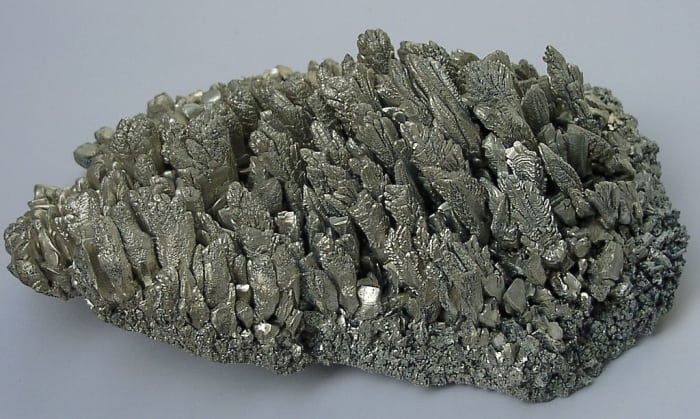
| Appearance | Shiny Grey Solid |
| Brinell Hardness | 44-260 MPa |
| Bulk Modulus | 35.4 GPa |
History Of Magnesium
The name Magnesium originates from the Greek word for locations related to the tribe of the Magnetes, either a district in Thessaly called Magnesia or Magnesia ad Sipylum, now in Turkey. It is related to magnetite and manganese which also originated from this area, and required differentiation as separate substance.
In 1618, a farmer at Epsom in England attempted to give his cows water from a local well. The cows refused to drink because of the water’s bitter taste, but the farmer noticed that the water seemed to heal scratches and rashes. The substance obtained by evaporating the water became known as Epsom salts and its fame spread. It was eventually recognized as hydrated magnesium sulfate.
The metal itself was first isolated by Sir Humphry Davy in England in 1808. He used electrolysis on a mixture of magnesia and mercuric oxide. Antoine Bussy prepared it in coherent form in 1831. Davy’s first suggestion for a name was “magnium”, but the name magnesium is now used in most European languages.
Further discoveries about magnesium were made by the father of physical chemistry in Imperial Russia, Nikolai Beketov (1827-1911), who established that magnesium and zinc displaced other metals from their salts under high tempatures.
Where is it used?
Magnesium is used in lightweight materials and alloys. For example when infused with silicon carbide nanoparticles, it has extremely high specific strength.
Historically, magnesium was one of the main aerospace construction metals and was used for German military aircraft as early as World War I and extensively for German aircraft in World War II. The Germans coined the name “Elektron” for magnesium alloy, a term which is still used today. In the commercial aerospace industry, magnesium was generally restricted to engine-related components, due to fire and corrosion hazards. Magnesium alloy use in aerospace is increasing in the 21st century, driven by the importance of fuel economy. Magnesium alloys can act as replacements for aluminum and steel alloys in structural applications.
This is all I know about Magnesium Thanks for reading!